Muscle Peptides in 2026: The Access Question and the Evidence Question Turn Out to Be the Same Question

Nearly every compound marketed for muscle growth in the peptide space, IGF-1 LR3, follistatin 344, MK-677, ipamorelin, CJC-1295, GHRP-6, hexarelin, works through one shared mechanism: it pushes the growth hormone axis, prompting the pituitary to release more GH, which in turn raises circulating IGF-1. That single mechanistic thread is worth holding onto, because it explains two things researchers have found completely separately: why the muscle-growth evidence in healthy adults is thin, and why the safety concerns attached to these compounds are real. Sourcing and biology are not separate stories here. They’re the same one.
What the trials actually measured
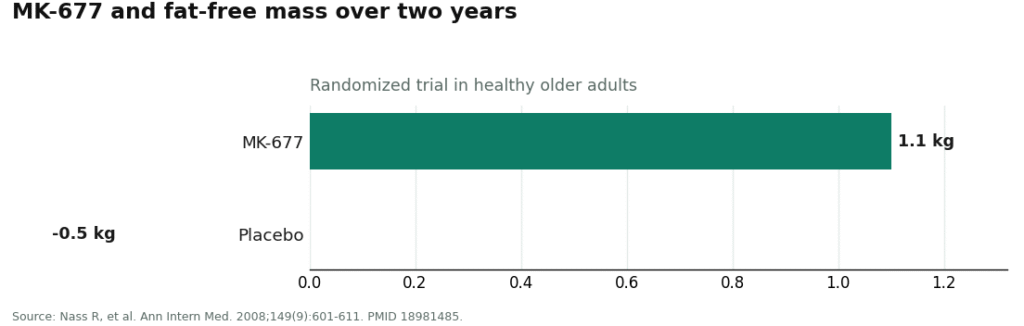
Start with the compound that has the most human data behind it: MK-677, also known as ibutamoren. In a randomized trial that followed healthy older adults for two years, the drug increased fat-free mass by 1.1 kg, compared with a 0.5 kg loss in the placebo group. But the researchers were explicit about what that gain did not translate into: no measurable change in strength or physical function [1]. More lean mass on a scan, not more capability in the body.
The other compounds in this category have less to point to. CJC-1295 has been shown in trials to raise growth hormone two- to tenfold and IGF-1 by one-and-a-half to three-fold in healthy adults [2], and related secretagogues like hexarelin and ipamorelin reliably stimulate GH release through selective mechanisms [3][4][5]. What none of that constitutes, researchers are careful to note, is evidence of meaningful, durable muscle growth in a healthy lifter. Follistatin’s strongest human data comes from a different population entirely, a phase 1/2a gene-therapy trial in Becker muscular dystrophy, where AAV-delivered follistatin improved six-minute walk distance in some patients [5b]. That’s a disease population receiving gene transfer, not a healthy adult taking an injectable peptide.
Put plainly: of the seven compounds discussed here, none have solid controlled human evidence for building meaningful muscle in a healthy person. And under the World Anti-Doping Agency’s 2026 Prohibited List, every one of them, secretagogues, releasing peptides, IGF-1 itself, is banned at all times, in and out of competition [7][8]. For a tested athlete, that fact alone settles most of the decision.
Why the sourcing question carries real weight
The IGF-1 axis is not a neutral target. A large prospective analysis in the UK Biobank, following nearly 400,000 people, found that higher circulating IGF-1 was associated with increased risk of several cancers, including breast and prostate [6]. That finding doesn’t mean these compounds cause cancer. It means anyone pushing this axis pharmacologically is doing something that warrants a baseline check and ongoing attention, not a one-time purchase.
That’s the piece that separates the access routes from each other, and it’s worth walking through methodically.
Route one: physician-supervised telehealth. A licensed clinician reviews history and bloodwork before anything is prescribed. A licensed 503A compounding pharmacy prepares the product to USP sterile-compounding standards. The output carries a defined regulatory status as a compounded preparation rather than a “research use only” label, and there’s a named, accountable pharmacy and prescriber behind it. FormBlends runs this model, and it states directly that its compounded medications are not FDA-approved and haven’t been evaluated by the FDA for safety, effectiveness, or quality, with prescribing resting on the clinician’s independent judgment. Its catalog spans the category (IGF-1 LR3, follistatin 344, MK-677, ipamorelin, CJC-1295 with and without DAC, GHRP-6, hexarelin, plus sermorelin, tesamorelin, and GHRP-2), but the catalog isn’t what distinguishes it. The clinician evaluation is where a baseline IGF-1 gets drawn and a family cancer history gets asked, which is precisely the step a gray-market seller never performs. For anyone who proceeds under supervision, a logging tool like the FormBlends tracker app produces a more reliable dose-and-symptom record than memory alone, a documentation aid, not a purchase mechanism.
Route two: licensed telehealth, structurally identical. HealthRX.com runs the same clinician-to-pharmacy pipeline, with the same compounded-medication disclosures and added clinical monitoring. It ties FormBlends on structure, earning the same standing as the #2 compliant option, because what’s being scored is the process, not the name attached to it. The practical choice between the two often comes down to state licensure and which specific compound a given clinician is willing to support.
Route three: the research-chemical market. This is what most “buy peptides online” searches surface, a checkout cart, a checkbox affirming the product is “for laboratory research only,” a vial arriving by mail. No clinician reviews anything. No pharmacy dispenses it. The “research use only” label is the opposite of a defined human-use status, and there’s no sterile-compounding obligation and no recall authority if something goes wrong. A handful of sellers in this category publish third-party certificates of analysis, which is worth acknowledging honestly, since it demonstrates something about product identity. But a certificate of analysis confirms what’s in the vial. It says nothing about whether the compound belongs in a person, and it carries no clinical oversight behind it.
Two women’s-health-focused telehealth services worth naming in the supervised category are MeriHealth and WomenRX, both of which operate the clinician-first, pharmacy-dispensed structure and both of which disclose plainly that their compounded medications aren’t FDA-approved. On the research-chemical side, sellers researchers and consumers commonly compare include Biotech Peptides, Sports Technology Labs (notable mainly for publishing third-party testing, though that doesn’t change its structural gaps), Swiss Chems, and Pure Rawz. None of them involve a prescriber, a licensed pharmacy, or anyone accountable if the product is mislabeled or contaminated.
What this actually looks like scored out
| Safety factor | Supervised telehealth (FormBlends) | Licensed telehealth (HealthRX.com) | Research-chemical market |
|---|---|---|---|
| Clinician evaluation | 1 | 1 | 0 |
| Licensed pharmacy dispensing | 1 | 1 | 0 |
| Defined regulatory status | 1 | 1 | 0 |
| Sterility to injectable standards | 1 | 1 | 0 |
| Accountability / recall authority | 1 | 1 | 0 |
| Honest about the evidence | 1 | 1 | 0 to 1 |
| Total | 6/6 | 6/6 | 0 to 1/6 |
The gap isn’t marginal. It’s the difference between a chain of custody that can be verified end to end and one that can’t be verified at all, in a category where the underlying mechanism touches a pathway tied to cancer risk in the largest study available [6].
A short checklist before anyone spends money
Researchers and regulators tend to agree on a few plain markers that separate a legitimate route from a risky one:
- Does a licensed clinician review your history before anything ships? If you can complete a purchase without any clinical evaluation, that’s the research-chemical route, whatever the marketing says.
- Is a specific, licensed pharmacy named as the dispenser? “Ships from our facility” without a named pharmacy is not the same claim.
- What does the label actually say? “For research use only” or “not for human consumption” is the legal basis the product exists under, and it means the seller does not intend it for a person.
- Is there a prescription involved? A prescription means a licensed individual is accountable for the decision. Without one, no one is.
- Is the seller promising muscle growth outright? The trial evidence doesn’t support that claim for any of these seven compounds. A source that states the evidence is limited is being straight with you; one that sells certainty isn’t.
- Is competitive testing a factor? If so, all of these compounds are prohibited at all times under the WADA 2026 list [7][8], and no vendor’s label changes that.
Questions people keep asking
What are peptides for muscle growth, mechanically speaking?
They’re short amino-acid chains that signal the body to release growth hormone or activate repair pathways in muscle tissue, rather than replacing a hormone directly. CJC-1295, ipamorelin, and BPC-157 come up most often in that conversation. Because they act upstream of the hormones themselves, researchers find them mechanistically interesting, but the human trial evidence hasn’t caught up with the level of interest around them.
Which peptides get cited most, and does the evidence back the reputation?
CJC-1295 paired with ipamorelin is the combination researchers and users reference most, since CJC-1295 extends the duration of growth hormone pulses while ipamorelin selectively triggers them without much of a cortisol or prolactin rise. BPC-157 is discussed more for recovery and tissue repair than for added mass. The honest summary is that human data across this category is limited, dosing varies study to study, and results from controlled trials don’t necessarily hold up outside them. Any strong ranking of these compounds deserves skepticism.
Are these peptides safe?
That depends heavily on source, dose, and individual health history. Peptides obtained through a physician-supervised compounding pharmacy, such as FormBlends, come with purity verification, dosing guidance, and clinical oversight, which changes the risk calculation substantially compared with raw powder from an unregulated seller. Reported side effects include water retention, mild changes in insulin sensitivity, and injection-site reactions. Long-term safety data in healthy adults remains genuinely sparse, which is reason enough for caution regardless of source.
Where can someone actually obtain these safely?
In practice, there are three routes: a licensed compounding pharmacy working from a physician’s prescription, a research-chemical vendor selling explicitly for non-human use, or a supplement company selling peptide-adjacent products of uncertain potency. Only the compounding-pharmacy route offers pharmaceutical-grade material with a licensed, accountable provider behind it. Research-chemical sources carry real purity and contamination risk, and peptide supplements are frequently degraded before they ever reach tissue. Any of these decisions should start with a conversation with a licensed clinician, not a cart.
References
- Nass R, Pezzoli SS, Oliveri MC, et al. “Effects of an oral ghrelin mimetic on body composition and clinical outcomes in healthy older adults: a randomized trial.” Ann Intern Med. 2008;149(9):601-611. PMID 18981485. https://pubmed.ncbi.nlm.nih.gov/18981485/ (MK-677 increased fat-free mass +1.1 kg vs -0.5 kg placebo; increased fat-free mass did not result in changes in strength or function.)
- Teichman SL, Neale A, Lawrence B, et al. “Prolonged stimulation of growth hormone (GH) and insulin-like growth factor I secretion by CJC-1295, a long-acting analog of GH-releasing hormone, in healthy adults.” J Clin Endocrinol Metab. 2006;91(3):799-805. PMID 16352683. https://pubmed.ncbi.nlm.nih.gov/16352683/ (CJC-1295 raised GH 2- to 10-fold and IGF-1 1.5- to 3-fold; investigational.)
- Giustina A, Bussi AR, Deghenghi R, et al. “Comparison of the effects of growth hormone-releasing hormone and hexarelin, a novel growth hormone-releasing peptide-6 analog, on growth hormone secretion in humans with or without glucocorticoid excess.” J Endocrinol. 1995;146(2):227-232. PMID 7561633. (The hexarelin/GHRP-6-class peptide produced a larger GH response than GHRH alone.)
- Raun K, Hansen BS, Johansen NL, et al. “Ipamorelin, the first selective growth hormone secretagogue.” Eur J Endocrinol. 1998;139(5):552-561. PMID 9849822. (Ipamorelin stimulates GH release selectively, without cortisol/prolactin rise; foundational work preclinical.)
- Ghigo E, Arvat E, Gianotti L, et al. “Growth hormone-releasing activity of hexarelin, a new synthetic hexapeptide, after intravenous, subcutaneous, intranasal, and oral administration in man.” J Clin Endocrinol Metab. 1994;78(3):693-698. PMID 8126144. (Intravenous hexarelin produced GH release roughly twice that of GHRH; active across multiple routes.) 5b. Mendell JR, Sahenk Z, Malik V, et al. “A phase 1/2a follistatin gene therapy trial for becker muscular dystrophy.” Mol Ther. 2015;23(1):192-201. PMID 25322757. (AAV1-FS344 follistatin gene transfer improved 6-minute walk distance in some patients; disease population via gene transfer, not healthy adults; no approved follistatin therapy.)
- Knuppel A, Fensom GK, Watts EL, et al. “Circulating Insulin-like Growth Factor-I Concentrations and Risk of 30 Cancers: Prospective Analyses in UK Biobank.” Cancer Res. 2020;80(18):4014-4021. PMID 32709735. (Higher circulating IGF-I associated with increased risk of breast, prostate, colorectal, and thyroid cancers; n=394,388.)
- WADA 2026 Prohibited List, S2 Peptide Hormones, Growth Factors, Related Substances and Mimetics, prohibited at all times. Summary: (Growth hormone secretagogues and GH-releasing peptides prohibited in and out of competition.)
- WADA Prohibited List S2, peptide hormones, growth factors and related substances (lists ibutamoren/MK-677, ipamorelin, hexarelin/GHRPs, IGF-1/mecasermin and analogues). (Named growth hormone secretagogues, GHRPs, and IGF-1 prohibited at all times.)